The
"March 2013 Watchlisting Guidance" was produced with the input of 19
agencies, including the CIA, Pentagon, NSA and FBI, and is officially
unclassified.
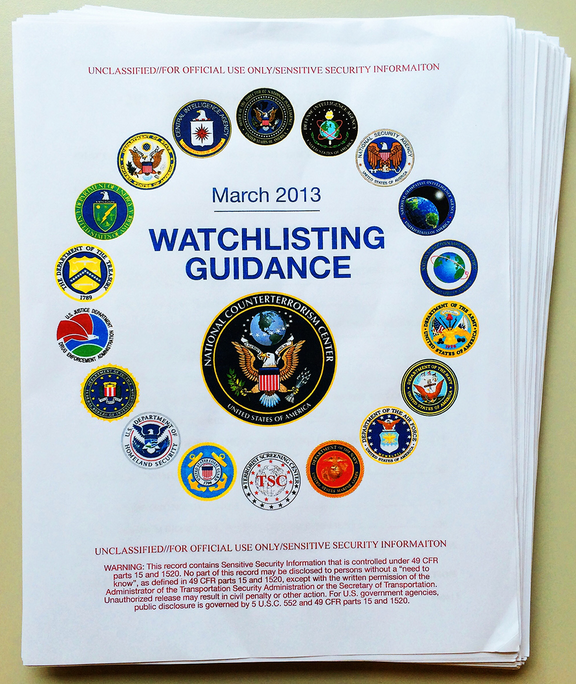
But as The Intercept's Jeremy Scahill reports, Attorney General Eric Holder has warned it is a "'clear roadmap' to the government's terrorist-tracking apparatus, adding: 'The Watchlisting Guidance, although unclassified, contains national security information that, if disclosed ... could cause significant harm to national security.'" The Intercept decided to publish the guidance despite the government's warning of threats to national security because the "system makes a mockery of the idea of due process," and that the public has a right to know about "what amounts to a shadow legal system." Said: Jeremy Scahill
You could Be a Terrorist According To Watchlisting Guidance Rulebook by Barbara Espinosa
But as The Intercept's Jeremy Scahill reports, Attorney General Eric Holder has warned it is a "'clear roadmap' to the government's terrorist-tracking apparatus, adding: 'The Watchlisting Guidance, although unclassified, contains national security information that, if disclosed ... could cause significant harm to national security.'" The Intercept decided to publish the guidance despite the government's warning of threats to national security because the "system makes a mockery of the idea of due process," and that the public has a right to know about "what amounts to a shadow legal system." Said: Jeremy Scahill
You could Be a Terrorist According To Watchlisting Guidance Rulebook by Barbara Espinosa
In order
to make the watchlist, neither "concrete facts" nor "irrefutable
evidence" are required, and a wide loophole exists that allows a single
White House official to add entire "categories" of people
unilaterally. Once a person is on the list, government agents are required to
collect detailed information from them during encounters at the airport or
elsewhere:
In
addition to data like fingerprints, travel itineraries, identification
documents and gun licenses, the rules encourage screeners to acquire health
insurance information, drug prescriptions, "any cards with an electronic
strip on it (hotel cards, grocery cards, gift cards, frequent flyer
cards)," multiple cellphones, email addresses, binoculars, peroxide, bank
account numbers, pay stubs, academic transcripts, parking and speeding tickets,
and want ads. The digital information singled out for collection includes
social media accounts, cell phone lists, speed dial numbers, laptop images,
thumb drives, iPods, Kindles, and cameras. All of the information is then
uploaded to the TIDE database.
Screeners are also instructed to collect any
"pocket litter," scuba gear, EZ Passes, library cards, and the titles
of any books, along with information about their condition -- "e.g., new,
dog-eared, annotated, unopened." Business cards and conference materials
are also targeted, as well as "anything with an account number" and
information about any gold or jewelry worn by the watchlisted individual. Even
"animal information" -- data about pets from veterinarians or
tracking chips -- is requested. The rulebook also encourages the collection of
biometric or biographical data about the travel partners of watchlisted
individuals.
The Obama administration has quietly approved a substantial
expansion of the terrorist watchlist system, authorizing a secret process that
requires neither “concrete facts” nor “irrefutable evidence” to designate an
American or foreigner as a terrorist, according to a key government document
obtained by The Intercept.
The new guidelines allow individuals to be
designated as representatives of terror organizations without any evidence they
are actually connected to such organizations, and it gives a single White House
official the unilateral authority to place “entire categories” of people the
government is tracking onto the no fly and selectee lists. It broadens the
authority of government officials to “nominate” people to the watchlists based
on what is vaguely described as “fragmentary information.” It also allows for
dead people to be watchlisted.
Over the years, the Obama and Bush
Administrations have fiercely resisted disclosing the criteria for placing
names on the databases—though the guidelines are officially labeled as
unclassified. In May, Attorney General Eric Holder even invoked the state
secrets privilege to prevent watchlisting guidelines from being disclosed in
litigation launched by an American who was on the no fly list. In an affidavit, Holder called them a “clear roadmap” to the
government’s terrorist-tracking apparatus, adding: “The Watchlisting Guidance,
although unclassified, contains national security information that, if
disclosed … could cause significant harm to national security.”


