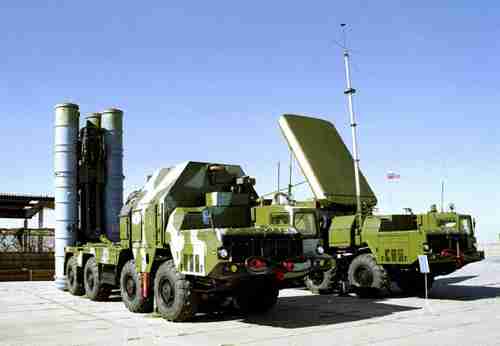
Russia's S-300 anti-aircraft missile systems (AP)
Russia said Tuesday that it would go ahead with the planned transfer of state of the art S-300 anti-aircraft missiles to the regime of Syria's psychopathic president Bashar al-Assad. The announcement was made in retaliation for Sunday's announcement by the European Union that its member nations had failed to reach agreement on extending the embargo, set to expire on Saturday, on weapons to al-Assad's opposition. Britain and France have led the demands to supply weapons to the opposition.
Russian Deputy Foreign Minister Sergei Ryabkov used strong language to criticize the EU decision and justify Russia's delivery of the S-300s:
"We think this delivery is a stabilizing factor and that such steps in many ways restrain some hotheads ... from exploring scenarios in which this conflict could be given an international character with participation of outside forces, to whom this idea is not foreign."Russia had previously promised Israel it would delay the S-300 delivery, so the new announcement represents a reversal, although no new delivery date was set. According to Israel's Defense Minister Moshe Yaalon:
"I can say that the shipments are not on their way yet. I hope they will not leave, and if, God forbid, they reach Syria, we will know what to do."What Yaalon means, presumably, is that Israel will launch air strikes, targeting the S-300 systems, if they reach Syria. The Israelis point out that the S-300s, with a range of 125 miles, are not purely defensive, since they can target Israel's civilian aircraft.
Britain's foreign secretary William Hague, said that Britain has not set a date either:
"We have said, we have made our own commitments, that at this stage, as we work for the Geneva conference, we are not taking any decision to send any arms to anyone."Both Britain and Russia gave similar reasons for their respective decisions -- that their side's weapons will provide stability to Syria. However, with Britain, France, Russia, Iran, Hezbollah in Lebanon, Saudi Arabia, Qatar and Turkey all supplying, or potentially supplying weapons to either side in Syria, and with the spilling over into Iraq and Lebanon, the country's sectarian proxy war took another giant leap forward on Tuesday. Reuters and Guardian (London)


