Thousands of Chinese held demonstrations, some of them
violent, against Japan's claims to the Senkaku/Diaoyu Islands, in cities across
China. Japanese officials warned citizens in China not to taxis alone or speak
loudly in Japanese while in public. In some cities, Japanese factories, grocery
shops, restaurants and car dealerships were damaged or looted. In Beijing, over
a thousand marchers hurled water bottles at the Japanese embassy, chanting,
"Knock down the little Japanese," "Long live the People's
Republic of China" and "China will prevail." The protests are
expected to continue at least through Tuesday, the 81st anniversary of Japan's
1931 invasion of Manchuria.
Demonstrations also spread to some American cities. About 1,000 people, organized by the Houston Diaoyu Islands Coalition, gathered Saturday morning at Chinatown in Houston to assert China's ownership of the Sankaku/Diaoyu Islands. In Chicago's Chinatown, more than 60 overseas Chinese organizations and business entities joined force in organizing anti-Japan protests on Saturday. LA Times and China Radio International
Demonstrations also spread to some American cities. About 1,000 people, organized by the Houston Diaoyu Islands Coalition, gathered Saturday morning at Chinatown in Houston to assert China's ownership of the Sankaku/Diaoyu Islands. In Chicago's Chinatown, more than 60 overseas Chinese organizations and business entities joined force in organizing anti-Japan protests on Saturday. LA Times and China Radio International
Taiwan rejects China's request to
join forces against Japan
Japan calls them the Sankaku Islands, and China calls them
the Diaoyu Islands. But Taiwan also claims them as being part of Taiwan (as
opposed to mainland China), and Taiwan calls them the Diaoyutai Islands.
Beijing considers Taiwan to be part of mainland China, and so has no objections
to Taiwan's claims on the disputed islands. China is requesting that Taiwan
cooperate with Beijing in opposing Japan's claims to the islands. But a
Taiwanese official responded:
"The Republic of China [Taiwan] has indisputable
sovereignty over the Diaoyutai Islands. In light of the long-running
sovereignty dispute across the Taiwan Strait, the idea of cross-strait
cooperation to resolve the territorial row is unseemly."
Leon Panetta says that China and
Japan are heading toward war
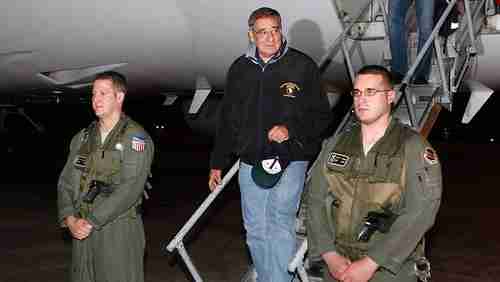
U.S. Secretary of Defense Leon E. Panetta warned that Asian
countries could end up in war if governments keep up their "provocative
behavior." According to Panetta:
"I am concerned that when these countries engage in
provocations of one kind or another over these various islands, that it raises
the possibility that a misjudgment on one side or the other could result in
violence, and could result in conflict.
And that conflict would then have the potential of expanding."
And that conflict would then have the potential of expanding."
Panetta made the remarks as he traveled to Asia, where he
plans to visit Japan, China and New Zealand.
To anyone who has been closely following this issue, as I have, it's perfectly clear that Panetta is right. China is provoking military confrontations with the Japanese near the Sankaku/Diaoyu/Diaoyutai Islands, and will not back down under any circumstances, while a backdown by Japan would be extremely humiliating and destabilizing. AFP
To anyone who has been closely following this issue, as I have, it's perfectly clear that Panetta is right. China is provoking military confrontations with the Japanese near the Sankaku/Diaoyu/Diaoyutai Islands, and will not back down under any circumstances, while a backdown by Japan would be extremely humiliating and destabilizing. AFP
Jund al-Sharia jihadists clash with
Egypt's army in Sinai
When Hosni Mubarak was president of Egypt, he was able to
keep the Sinai, the region near the border with Israel populated by Bedouins,
under tight control. Since Mubarak's overthrow, the Sinai has become
increasingly lawless, and infiltrated by al-Qaeda linked militants,
particularly Jund al-Sharia in recent months. On August 5, armed militants
ambushed and killed 16 Egyptian soldiers on the border with Israel. The public
was furious with the new president Mohamed Morsi especially when it was
revealed that Israeli intelligence had warned the Egyptians in advance that an
attack was coming. Morsi reacted by send army units into the Sinai to root out
the militants, but the effort has been largely a failure.
On Sunday, al-Qaeda linked militants attacked Egypt's security headquarters in northern Sinai with machine guns and mortar bombs and fought troops elsewhere in the desert region, killing one soldier and wounding seven. Two days earlier, on Friday, militias stormed a base housing the international peacekeeping force, the Multinational Force and Observers (MFO), wounding four. The MFO was established in 1981 to implement the 1979 peace treaty between Israel and Egypt. The base has some 1000 MFO personnel, mostly Colombian and Fijian, and is commanded by the U.S. It's believed that Jund al-Sharia was responsible for all these attacks. Long War Journal and Australian AP and Israel National News
Debka, which sometimes gets things wrong, is quoting its military intelligence sources as saying that Sunday's attacks by Salafi Bedouin and al-Qaeda militia market a major and dangerous escalation in the Sinai situation, and that the jihadists now plan to attack Israeli targets. Debka assigns the blame to a different al-Qaeda linked group, the Army of Islam, which it says are now "at the forefront of the violent Islamist protest against the United States sweeping across the Middle East and Asia." Debka notes that because of other international issues, there is little public knowledge of the true impact. Debka
On Sunday, al-Qaeda linked militants attacked Egypt's security headquarters in northern Sinai with machine guns and mortar bombs and fought troops elsewhere in the desert region, killing one soldier and wounding seven. Two days earlier, on Friday, militias stormed a base housing the international peacekeeping force, the Multinational Force and Observers (MFO), wounding four. The MFO was established in 1981 to implement the 1979 peace treaty between Israel and Egypt. The base has some 1000 MFO personnel, mostly Colombian and Fijian, and is commanded by the U.S. It's believed that Jund al-Sharia was responsible for all these attacks. Long War Journal and Australian AP and Israel National News
Debka, which sometimes gets things wrong, is quoting its military intelligence sources as saying that Sunday's attacks by Salafi Bedouin and al-Qaeda militia market a major and dangerous escalation in the Sinai situation, and that the jihadists now plan to attack Israeli targets. Debka assigns the blame to a different al-Qaeda linked group, the Army of Islam, which it says are now "at the forefront of the violent Islamist protest against the United States sweeping across the Middle East and Asia." Debka notes that because of other international issues, there is little public knowledge of the true impact. Debka
Last year's floods were Thailand's worst disaster in living
memory. Since then, the country has been doing as much as possible to prevent a
recurrence. Water management through Bangkok has been improved, including the
dredging of over 500 kilometers of canals in Bangkok. Reinforced walls have
been built around industrial centers, after worldwide availability of hard
disks and other computer components was crippled over flooding at Bangkok
factories for companies like Hitachi, Nikon, Sony and Honda. But in the long
run, it's a losing battle. The increasing population is sucking up ground
water, causing parts of Bangkok to sink further. And architecture firm made
headlines recently when it designed a Bangkok cityscape floating on water. By
2030, Bangkok may have become a modern-day Atlantis. The Diplomat
Europeans have mixed emotions about
President Obama's foreign policy
In my opinion, Barack Obama's most important speech in the
2008 campaign was his speech in Berlin, which I wrote about in July, 2008, in "Barack Obama in Berlin calls for greater
European militarism,". The German press said that "Germany
has caught Obamania!" as he faced huge, wildly enthusiastic crowds. What
was obvious at the time was that the German people and the German press paid no
attention to what Obama was actually saying, which was highly militaristic, but
with promises to significantly improve America's image in the Arab and Muslim
world.
Today, the German press are saying that Obama's Mideast policies have failed and "Obama's Middle East policy is in ruins," although the same commentators hasten to add that Mitt Romney's reaction was "not just nonsense, but partisan maneuvering." One German commentator wrote of the Arab nations, "America hardly has influence in the region any longer, and now sees itself confronted with anti-American sentiment in places where it no longer controls the dictators. Meanwhile, forces that simultaneously exploit and spurn America are gaining influence."
However, there is still one group of Europeans that unabashedly adore President Obama - the minorities in France. Obama’s 2008 victory had an explosive impact here, shining a harsh light on the dearth of French blacks or Arabs in positions of power and offering the country’s minorities a new source of inspiration. For example, Anthony Borval, a 29 year old black Frenchman of Caribbean descent, says:
Today, the German press are saying that Obama's Mideast policies have failed and "Obama's Middle East policy is in ruins," although the same commentators hasten to add that Mitt Romney's reaction was "not just nonsense, but partisan maneuvering." One German commentator wrote of the Arab nations, "America hardly has influence in the region any longer, and now sees itself confronted with anti-American sentiment in places where it no longer controls the dictators. Meanwhile, forces that simultaneously exploit and spurn America are gaining influence."
However, there is still one group of Europeans that unabashedly adore President Obama - the minorities in France. Obama’s 2008 victory had an explosive impact here, shining a harsh light on the dearth of French blacks or Arabs in positions of power and offering the country’s minorities a new source of inspiration. For example, Anthony Borval, a 29 year old black Frenchman of Caribbean descent, says:
"It was intense, I felt almost American. Obama
indirectly sent us a message that anything was possible, a message of hope for
minorities in France, where it’s difficult for us to succeed. ...
His victory taught French people of colour to believe in ourselves. Today, I still feel great pride that an African-American is running the world’s superpower."
From the point of view of Generational Dynamics,
if you ignore rhetoric, then there's little difference in outcomes if Obama's
first term had instead been President Bush's third term. What I think is
interesting about this situation is the difference between
"likeability" and "policy," a difference that appears to be
extremely important in the current election. Polls indicate that Obama is far
more "likeable" than Romney, but many Obama supporters are extremely
disillusioned about Obama's policies. His victory taught French people of colour to believe in ourselves. Today, I still feel great pride that an African-American is running the world’s superpower."
A historical example of this difference is Winston Churchill. He was not well liked, but he became prime minister because of his policies toward the Nazis. Churchill was still disliked during WW II, and was thrown out of office a nanosecond after the war ended. So as a new world war approaches, anyone still alive when the war ends will have leave to contemplate the roles that likeability and policy played in the war. Spiegel and France 24
Source Permanent web link to this article


