Federal Reserve Chairman Ben Bernanke warned us repeatedly that he would
repress interest rates indefinitely in order to help the economy and the housing
market. Interest rates on government treasury securities have reached all time
lows and bank depositors are receiving close to a zero return on their savings.
Meanwhile, both housing and the economy remain flat on their backs despite Mr.
Bernanke’s zero interest rate policy (ZIRP).
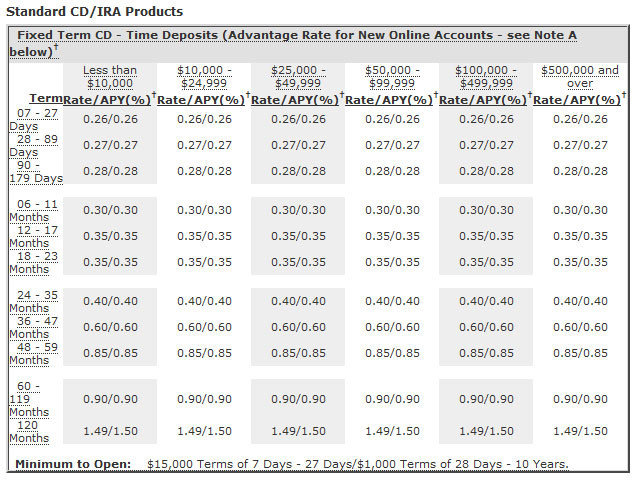
Savers looking for a rate
above 1% on a CD would have to tie up their money
for a ridiculously long period of time. A 10 year CD yields only 1.5% – does
anyone believe that this return will outpace inflation over the next 10 years?
After taxes and inflation, bank savers are reaping a negative rate of return.
Shown below are the current rates offered by Bank of America.
Source: Bank of America
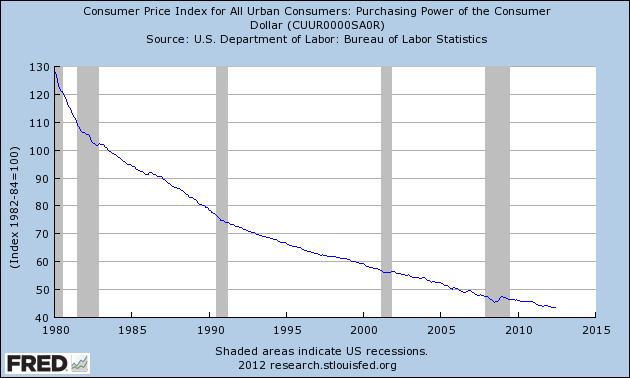
The devastating decline in the purchasing power of U.S. dollar since 1980 is
shown below (graph courtesy of Federal Reserve Bank of St. Louis).
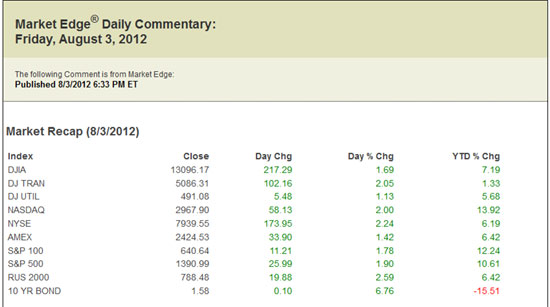
Exactly where should a saver have put his money this year? The stock and bond
markets have been on a tear this year as a result of the super easy monetary
policies of the Federal Reserve. Here are the returns as of today’s market
close. Note that the result for bonds indicate a decline in yields which
translates into higher prices (gains) for holders of long term U.S. treasury
securities.
Courtesy: Charles Schwab
Naturally, there is a good reason people keep all or a part of their savings
in the banks – they do not want to risk a loss of principal and feel reassured
since the FDIC provides deposit insurance. In addition, the past decade has
shown us that stock markets have an unsettling tendency to suffer major sell
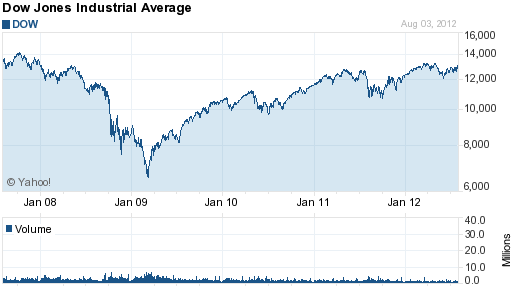
offs resulting in huge losses for investors. The Dow Jones Industrial Average,
for example, is no higher today than it was in 2007 and during the financial
crisis of 2008, the Dow plunged a horrifying 50%.
Dow Jones - courtesy yahoo finance
Going forward, in a twisted world of inflation, massive government deficits
and interest rate manipulation by the Federal Reserve, it may be extremely
challenging for any asset class to provide a positive real rate of return to
either investors or bank depositors.


