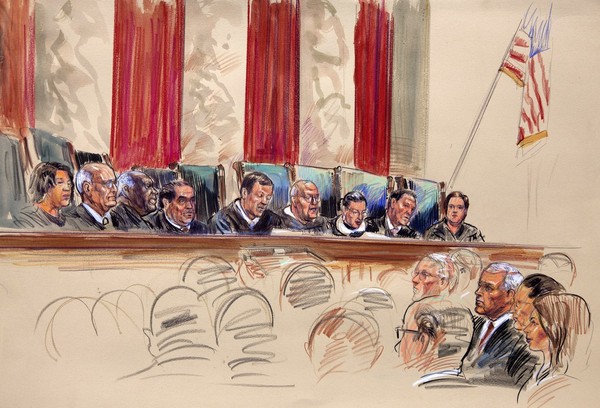
Did Supreme Court Justice John Roberts choose ‘judicial restraint’ over ‘originalism’ when ruling on ObamaCare? Interview with Stephen B. Presser, a professor of legal history at Northwestern University’s School of Law (check out his latest CNN.com piece on the ruling.) Presser was critical of the decision, calling the notion that the mandate was, in fact, a tax, “contrived and unsatisfactory,”
http://mattlewis.org/?feed=podcast
Listen to Matt Lewis interview with Professor Presser
CNN) -- A little more than 400 years ago a king of England, James
I, was informed by one of his judges, Edward Coke, that while the king was
under no man, he was under God and the law. This was one of the earliest and
most powerful suggestions that our legal system (borrowed from the English)
had, as its core principle, that there must be some restraint on arbitrary
power. Ours is supposed to be a government, as John Adams wrote in the
Massachusetts Constitution of 1780, of laws and not of men.
In what will go down as
one of the most important Supreme Court decisions of the 21st century, a
majority of the justices have affirmed that most noble and important of
Anglo-American legal maxims. But the court's opinion, in preserving the
Patient Protection and Affordable Care Act, under Congress' taxing
power, still gives a virtually unlimited sway to the power of the federal
government.
The court's opinion is a long one, and will be carefully parsed by
legal scholars, but the bottom line is not difficult to discern. Chief Justice
John Roberts has, whether he makes it clear in his opinion or not, chosen to
leave the determination of the scope of Congress' powers to Congress itself,
and to the American people, who place their representatives in Congress.
How the Supreme Court voted, what they wrote. The
argument against the Affordable Care Act was that the individual mandate, by
requiring virtually all adult Americans to buy health insurance or
pay a penalty, could not be justified under the commerce power, because instead
of regulating commerce, the act was an attempt to compel participation in
commerce. The chief justice and Justices Antonin Scalia, Anthony Kennedy,
Clarence Thomas and Samuel Alito all now concede that that argument was
correct, and that there must be some limits to the power of the federal
government when it seeks to regulate interstate commerce. This was the clear
holding of prior Supreme Court cases as well.


