Source
Home Savings of America, which was established during the depths of the Great Depression, was closed by regulators today. The Bank was established on September 1, 1934 and operated as a federally chartered stock savings and loan association, headquartered in Little Falls, Minnesota.
According to Home Savings of America’s website, the Bank’s niche was serving senior citizens with products appropriate for a retired stage of life. The Bank offered many products rarely seen by banks today such as free checking accounts and no fee travelers checks. Home Savings of America also specialized in mortgage lending which proved to be its undoing as real estate values crashed along with the economy in 2008.

Home Savings of America was a relatively small bank with under $100 million in assets until 2004. Swept up by the real estate boom and easy lending practices, Home Savings ramped up its lending at an incredible pace starting in 2005 and by 2008 (the peak of the real estate bubble), the Bank’s assets had exploded to almost $450 million.
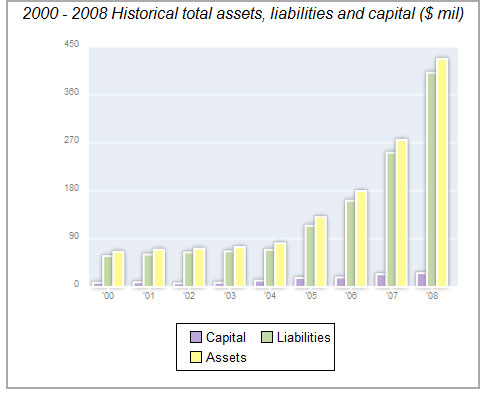
Home Savings - courtesy faqs.org
It was relatively easy to conduct huge amounts of mortgage transactions during the real estate boom since borrowers with relatively low credit scores could borrow with nothing down and without verifying income. The Office of the Comptroller of the Currency (OCC) which closed down Home Savings noted that the Bank “had experienced substantial dissipation of assets and earnings due to unsafe or unsound practices.” The OCC had issued a Cease and Desist Order to Home Savings in July 2010 citing “unsafe and unsound practices” but the Bank was unable to cure the operational and financial deficiencies cited by the OCC.
After shutting down Home Savings of America, the OCC appointed the FDIC as receiver. The FDIC was unable to find a buyer willing to purchase Home Savings. Typically, the FDIC is able to attract a purchaser for a failed bank with generous guarantees to cover losses on failed banks through the use of loss-share agreements.
Potential purchasers may not be interested in purchasing a failed bank for a variety of reasons. A bank buying a failed bank does so with the expectation of expanding their banking operations in a profitable manner. If the asset quality of a failed bank is very poor, the FDIC may not be able to find a buyer under any circumstances and this is what occurred with the failure of Home Savings of America.
Although it is unusual for the FDIC to be unable to attract successful bids for a failed bank, the case of Home Savings is not unique. During 2011, the FDIC was unable to find a purchaser for two failed banks. Between January 2009 to December 2010, the FDIC could not find buyers for 19 banks and was forced to liquidate the banks and payoff depositors.
At December 31, 2011, Home Savings of America had total assets of $434.1 million and total deposits of $432.2. The FDIC will be forced to retain all of the assets of Home Savings. The FDIC already holds $30 billion of junk assets (technically known as “resolution receivables balance”) that it has accumulated from other failed banks and was unable to sell (see FDIC Has A $30 Billion Junk Loan Problem).
The failure of Home Savings will be handled by the FDIC as a payout. Checks to depositors will be mailed out on Monday, February 27, 2012, up to the deposit insurance limit of $250,000.
One unique but discomforting aspect of a failed bank that cannot be sold is that depositors may very well wind up losing money. Typically when a bank fails, the purchaser of a failed bank will assume all deposits, meaning that depositors over the FDIC insurance limits do not lose any of their money. In this case, depositors who are above insurance limitations are looking at the worst aspect of a bank failure – the painful loss of depositor savings.
Here is what the FDIC had to say to regarding accounts above $250,000.
1. What if I have more than $250,000 in my accounts at Home Savings of America?
If you have more than $250,000 in your interest-bearing account, or if the total of your related interest-bearing accounts exceeds $250,000, your accounts may require review by an FDIC Claim Agent. You should call the FDIC to schedule a telephone appointment with an FDIC Claim Agent at .If you have an interest-bearing account or group of interest-bearing accounts that exceeds $250,000, you may need to complete certain declarations or affidavits and provide documentation so that the FDIC can make an insurance determination on your account(s).
The FDIC estimated the loss to the Deposit Insurance Fund at $38.8 million. This amount seems to be unusually, almost suspiciously low, compared to previous banking failures and after considering the fact that Home Savings had such poor asset quality that the FDIC could not attract a buyer.
The “estimated loss” on Home Savings amounts to only 9% of total assets. By comparison, for all of 2011, the ratio of losses on failed banks to total assets of failed banks was 20%. The ratio of losses to total assets for 2012 bank failures prior to today was 31.5%. The loss estimates on failed banks are subject to later revision and it will be interesting to see by how much the “loss estimate” on Home Savings later expands.
Home Savings of America is the 11th banking failure of 2011 and the second in Minnesota.


