In its capacity as receiver for failed banks, the FDIC is responsible for either selling or winding down the operations of failed banks. In the vast majority of cases, the FDIC is able to sell a failed bank to a purchaser who agrees to purchase some or all of the assets of the failed institution.
In order to attract bids on failed banks, the FDIC agrees to absorb a large percentage of future losses on asset pools sold to purchasers of failed banks through the use of loss-share transactions. According to the FDIC, the use of loss-share transactions “maximizes returns of the assets by keeping them in the private sector”.
Despite the generous terms given to purchasers of failed banks under loss-share transactions, purchasers of failed banks often refuse to buy all of a failed bank’s assets. Purchasers may refuse to purchase certain failed bank assets due to a variety of reasons, including loan default or extremely poor collateral. As receiver, the FDIC retains any failed bank assets that it cannot sell, which are classified as “resolution receivables.” Over the past four years, the FDIC has accumulated a massive $30 billion portfolio of failed bank assets that it could not sell.
From nearly nothing in 2007, the FDIC’s mountain of junk failed bank assets swelled to $38.4 billion at September 30, 2009. Over the following year, the FDIC reduced this amount to $29.5 billion but has since made little progress in reducing its portfolio of failed bank assets. Despite the fact that the FDIC was able to sell the vast majority of assets held by the 92 banks that failed during 2011, the resolution receivables balance declined by only $200 million to $29.3 billion as of the last reporting period ending September 30, 2011.
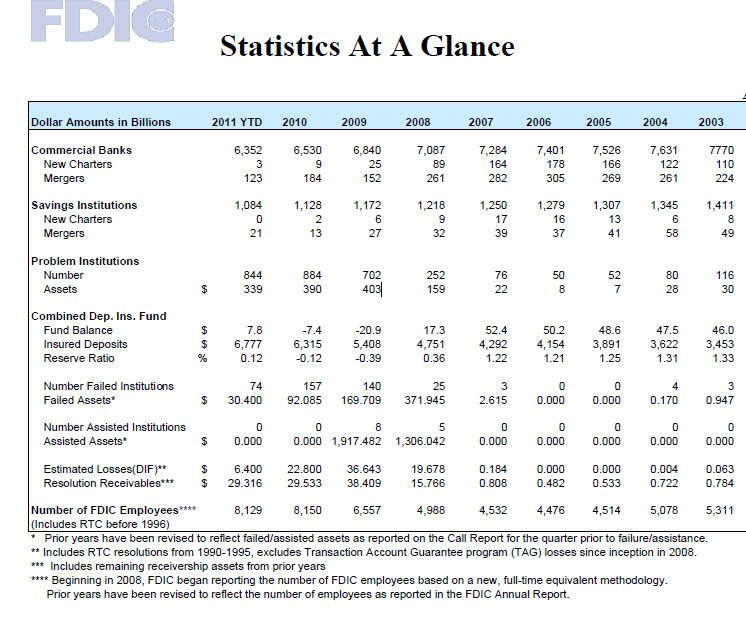
- Total assets of the 92 banks that failed during 2011 totaled $36 billion.
- The FDIC Deposit Insurance Fund (DIF) currently has a balance of only $7.8 billion which provides insurance protection on a staggering $6.78 trillion in deposits.
The decline of residential real estate values has been relentless since 2007 and the Wall Street Journal reports this week that the commercial office market is weakening significantly.
Defaults and foreclosures are rising. The delinquency rate of office loans that were securitized hit 9% in December, up from 7.4% in June.If the FDIC could sell their massive portfolio of failed bank assets at anything near carrying value they would. However, with a severely depleted Deposit Insurance Fund, the FDIC cannot afford to take large losses by dumping resolution receivables at market prices. The FDIC is playing the same “extend and pretend” game as the banks, hoping that property values recovery while avoiding the recognition of losses that in reality already exist.
Rents in most markets are still well below what they were in 2007, with the drop in some areas as much as 26%…
When the FDIC is able to sell failed bank assets, it is usually at a very steep discount to unpaid principal balance of the loans involved. In addition, the FDIC often provides very low rate financing for the purchaser and retains a large interest in the asset pool “sold”.
The latest sale of resolution receivables reported today by the FDIC involved a small pool of assets with an unpaid principal balance of $101 million. A 25% interest in the loan pool involved was sold at a discount of 46% to unpaid principal. The FDIC retained the other 75% of the asset pool and received a cash payment of only $13.6 million from the purchaser, according to the FDIC press release.
The Federal Deposit Insurance Corporation (FDIC) has closed on the third sale in its Small Investor Program (SIP). The competitive bidding process involved the sale of a 25 percent initial equity stake in a limited liability company (LLC) formed by the FDIC in its receivership capacity to hold certain loans of the Bank of Whitman, Colfax, Washington, which failed on August 5, 2011.Without considering additional failed bank assets that the FDIC may be forced to acquire from future failed banks, it will be decades before the FDIC disposes of its vast portfolio of failed bank assets.
The loans transferred to the LLC consisted of 62 performing and non-performing commercial real estate loans, commercial acquisition and development and construction loans, as well as performing and non-performing residential acquisition, development and construction loans. The collateral is located primarily in Washington, Idaho and Utah, and has an aggregated unpaid principal balance (UPB) of $101,007,866.
The purchaser of the initial equity stake in the LLC was Mariner Real Estate Partners III, LLC, Leawood, Kansas, which is a minority-owned business.
Mariner paid approximately $13.6 million (net of working capital) in cash for its initial 25 percent stake in the LLC; its bid valued the loans at approximately 54 percent of the aggregate UPB. Mariner will provide for the management, servicing and ultimate disposition of the LLC’s loans.
Source
Related posts:


