Cross Post
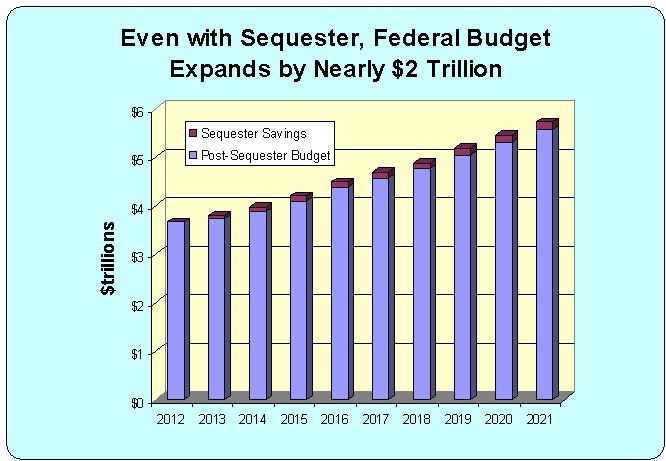
Some people have asked why I’m so agitated about the possibility that Republicans may acquiesce to tax increases as part of the Supercommittee negotiations.Rather than get into a lengthy discourse about the proper role of the federal government or an analysis of how the Bush-Obama spending binge worsened America’s fiscal situation, I think this chart from a previous post says it all (click to enlarge).

But as the chart illustrates, that is utter nonsense.
There are only budget cuts if you use dishonest Washington budget math, which magically turns spending increases into spending cuts simply because the burden of government isn’t expanding faster than it potentially could.
If we use honest math, we can see what this debate is really about. Should we raise taxes so that government spending can grow by more than $2 trillion over the next 10 years?
Or should we have a sequester so that the burden of federal spending climbs by “only” $2 trillion?
The fact that this is even an issue tells us a lot about whether the GOP has purged itself of the big-government virus of the Bush years. (more…)
Daniel J. Mitchell is a top expert on tax reform and supply-side tax policy. Mitchell is a strong advocate of a flat tax and international tax competition. Prior to joining Cato, Mitchell was a senior fellow with The Heritage Foundation, and an economist for Senator Bob Packwood and the Senate Finance Committee. He also served on the 1988 Bush/Quayle transition team and was Director of Tax and Budget Policy for Citizens for a Sound Economy. His articles can be found in such publications as the Wall Street Journal, New York Times, Investor's Business Daily, and Washington Times. He is a frequent guest on radio and television and a popular speaker on the lecture circuit. Mitchell holds bachelor's and master's degrees in economics from the University of Georgia and a Ph.D. in economics from George Mason University.